
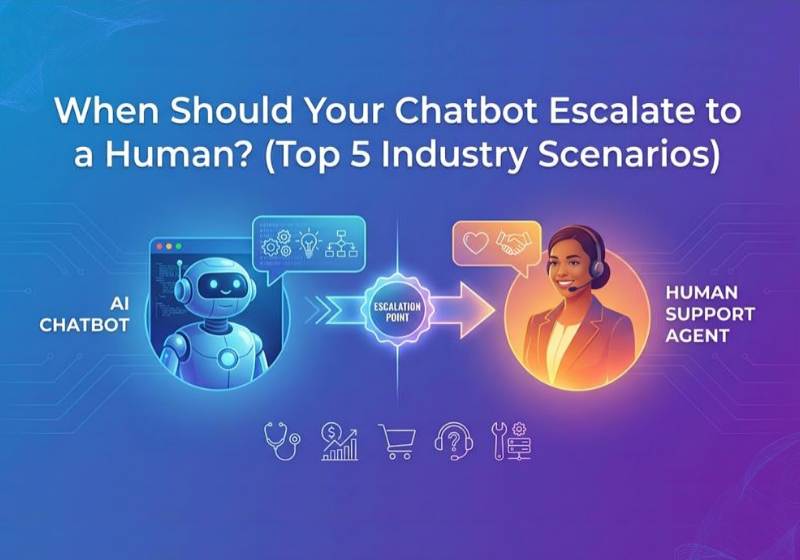
Chatbots have become a staple in customer service across industries, with the AI chatbot handling a huge volume of routine questions 24/7. In fact, AI chatbots can now autonomously handle up to 70% of customer inquiries. However, the remaining interactions the tricky, sensitive, or unexpected ones are where human assistance is crucial.
A well-designed chatbot knows its limits and hands off to a human at the right moment, which is essential for preserving customer satisfaction and efficiency. Escalating to a human (whether via live chat, email follow-up, or a phone call) at the correct time isn’t a failure of the bot; it’s a smart strategy to prevent user frustration and resolve issues that automation alone cannot handle.
Key Escalation Triggers
- Customers repeating themselves with no progress
- Explicitly asking for a person
- Showing signs of confusion or anger
- Raising issues outside the bot’s scope
The key is recognizing when to offer that human touch. Common red flags include customers repeating themselves with no progress, explicitly asking for a person, showing signs of confusion or anger, or raising issues outside the bot’s scope. If the chatbot ignores these cues, the experience can quickly sour and erode trust. In this blog, we’ll explore five major industries and highlight scenarios in each where a chatbot should proactively offer a human assist (via a support agent or scheduled call/email) to keep users happy and supported.
1. E-Commerce & Retail: From Simple Questions to Complex Complaints
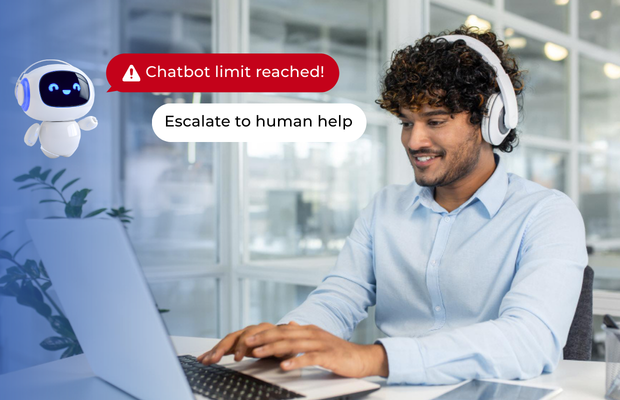
Online retail chatbots are great for instant answers about product details, order status, or return policies. But when a shopper’s request gets too complex or falls outside the bot’s capabilities, it’s time to loop in a human.
For example, Sephora’s customer support bot will capture the user’s contact info and ensure a human follows up whenever a query goes beyond what the bot can handle. In practice, this means if a customer asks something highly specific or unusual (like a nuanced product usage question or a unique shipping request), the chatbot should stop guessing and offer a human representative, rather than risk frustrating the shopper with irrelevant answers.
Key E-Commerce Escalation Scenarios
- Complex Product Inquiries
- Nuanced product usage questions
- Unique shipping requests
- Custom product configurations
Policy Exceptions
- Returns past deadline
- Special accommodation requests
- Dissatisfied customer complaints
Another scenario is handling policy exceptions or dissatisfied customers. Imagine a customer trying to get a refund on an item a week past the return window a typical chatbot might initially respond with the standard policy. If the user pushes the issue or repeats their request, the bot should promptly escalate.
In e-commerce, certain cases need human judgment and empathy: if someone requests a refund after the official period has expired, the AI can gather the details, but a human agent should step in to review and possibly approve an exception to preserve customer goodwill. By handing off such cases (especially when the customer has already asked twice or is getting upset), the chatbot prevents a minor policy issue from turning into a lost customer. In short, retail bots should offer a human help option whenever the conversation goes in circles, the customer is unhappy with the automated responses, or an out-of-policy request comes up. A friendly message like, “Let me connect you with a team member who can assist further,” at the right moment can make all the difference.
2. Banking & Financial Services: Sensitive Issues and Complex Queries
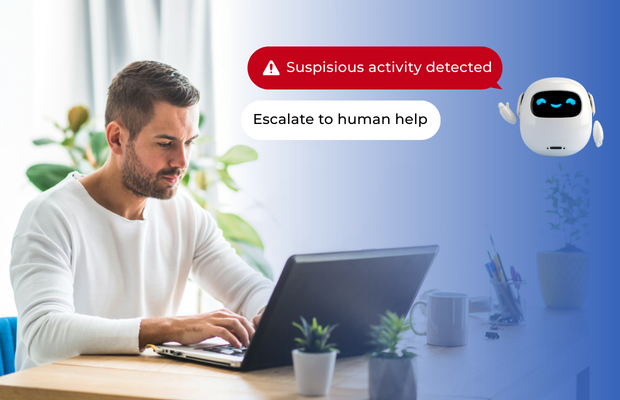
Banks and financial institutions use chatbots to answer questions about balances, transfers, or branch hours. But the stakes are high with money matters, so certain triggers demand instant human escalation.
A prime example is anything involving potential fraud or security concerns. Bank of America’s Erica chatbot, for instance, uses AI to detect suspicious account activity and will immediately connect the customer to a fraud specialist when red flags appear. During the handoff, Erica passes along context like the transaction history, so the human agent is up to speed a seamless transition that saves the panicked customer from re-explaining the issue. This quick escalation is critical because a customer who thinks their account is compromised is likely anxious or upset; they need the reassurance and personal touch of a human agent who can confirm the steps being taken to secure their finances. In general, whenever a banking bot detects emotional language or urgent issues (e.g. “My card was stolen” or “I never authorized this charge”), it should offer to involve a live agent right away.
Critical Escalation Trigger in Banking
- Fraud or Security Concerns: Immediate escalation when suspicious activity is detected or reported.
- Emotional Language: Customer expressing panic, anger, or distress about financial matters.
- Complex Financial Advice: Requests requiring personalized guidance or policy exceptions.
- Compliance Requirements: Situations requiring human oversight for regulatory reasons.
Another area in finance is the need for nuanced advice or exceptions. Financial products can be complex, and customers sometimes ask questions that go beyond a simple FAQ. For example, in the insurance sector (often grouped with financial services), consider a user who says: “My policy lapsed while I was hospitalized last month – can I still file a claim?” This isn’t a yes/no question with a canned answer – it’s a unique, empathetic conversation that AI alone cannot resolve satisfactorily. The chatbot should recognize it’s out of its depth and swiftly hand off to a human agent who can discuss options or make case-by-case judgments.
Similarly, compliance requirements in banking and insurance often mandate human oversight. A bot might collect initial information for a loan application or a KYC verification, but final approvals or sensitive confirmations should be done by a person. In these scenarios – complex queries, emotional situations, or regulatory checkpoints – a banking chatbot best serves the customer by saying, “I’m going to get a specialist to help with this,” and then facilitating a direct conversation via secure chat or arranging a phone call. This approach ensures customers feel their issues are handled with care and expertise, not just automated responses.
3. Healthcare: When Virtual Assistants Need a Human Doctor or Nurse
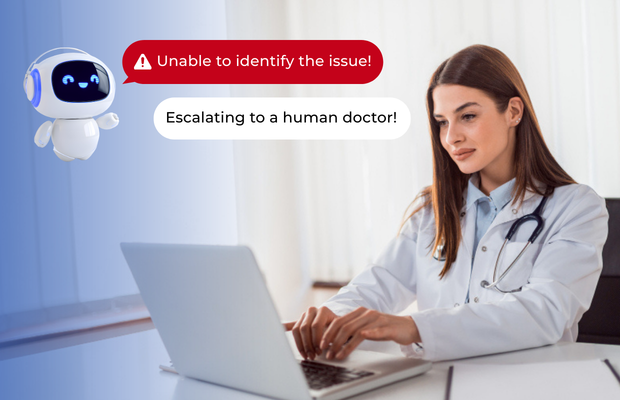
Healthcare chatbots, including a chatbot for healthcare, are being used for everything from symptom checking and appointment booking to medication reminders. They provide quick answers for common health FAQs and can help triage simple issues. However, patient health is very personal and can turn critical, so healthcare bots must know when to urgently involve a human clinician. A clear-cut rule is to escalate when you see signs of a medical emergency or serious concern.
For instance, UCHealth’s “Livi” virtual assistant capably handles basic health inquiries, but if a user types something like “I have chest pain” or other emergency keywords, Livi immediately alerts medical staff and forwards the patient’s info for an urgent follow-up. Similarly, Babylon Health’s AI chatbot evaluates symptoms and then seamlessly connects patients with real doctors for further consultation when needed. In practice, a healthcare bot should be programmed to recommend a human or even call emergency services if a conversation indicates any life-threatening issue or if the user is clearly in distress. There’s no room for a chatbot to play doctor in edge cases a human must step in right away.
- Emergency Escalation Triggers
- Chest pain or breathing issues
- Signs of stroke or heart attack
- Severe pain or distress
- Mental health crisis indicators
Even outside of emergencies, nuance and empathy are vital in healthcare conversations. Health queries can be complex or anxiety-inducing, and a chatbot for healthcare must be able to recognize these situations. If a patient keeps rephrasing a question about a worrisome symptom, or appears confused by the bot’s explanation of a condition, that’s a signal for the chatbot to offer a human health professional. A nurse or support agent can then speak with the patient (via chat or a phone call) to provide reassurance, clarification, or schedule an in-person appointment. Also, many medical tasks are governed by strict rules: for example, confirming a prescription refill or giving personalized medical advice often requires a licensed human professional for compliance and safety reasons.
In these cases, the bot should gracefully transition to a human – for instance, saying “I’m going to connect you with our medical team to help with that” – rather than attempting an answer. By doing so, healthcare chatbots ensure that patients get speedy service for routine needs, but also timely human care when the situation calls for deeper expertise or compassion. This hybrid approach builds trust, as users know the bot will not overstep its bounds.
4. Travel & Hospitality: Balancing Automation with the Human Touch

Hotels, airlines, and travel companies use chatbots as virtual concierges, answering questions about bookings, check-in times, baggage policies, and more. These bots shine for quick info and simple requests (like providing a hotel Wi-Fi password at 2 AM). But travel is an industry where customers highly value the human touch, especially when something goes wrong. If a guest’s request becomes complex, emotional, or off-script, the chatbot should offer human help without hesitation.
For example, imagine a hotel chatbot handling an upset guest who complains, “My room is still dirty and I’ve asked twice!” or a traveler saying, “I missed my flight, what do I do now?” These are moments where empathy and creative problem-solving are needed. The best hospitality bots have an escalation protocol that smoothly hands over the conversation to a human staff member in complex situations requiring judgment – such as handling a complaint or an unusual request while carrying over the chat history for continuity. In practice, that means the guest doesn’t have to repeat their issue; the human agent picks up seamlessly, aware of what the bot and user have already discussed. This kind of warm handoff is crucial when dealing with a frustrated customer or a scenario the bot wasn’t programmed to handle.
When Travel Bots Should Escalate
 Travel Emergencies:
Flight cancellations, missed connections, or urgent rebooking needs Customer Complaints:
Service issues, room problems, or dissatisfaction requiring empathy Complex Requests:
Special accommodations, unique itinerary changes, or policy exceptions Explicit Requests:
When customers directly ask to speak with a human representative
Time-sensitive travel crises are another trigger for escalation. If a chatbot for an airline detects a customer is dealing with a cancelled flight or other urgent disruption, it should quickly offer to connect the person with a live agent or possibly even arrange a phone call. Travel plans often involve stress, and a delayed response or a rigid bot script can amplify a customer’s frustration.
Research in hospitality tech shows that while AI assistants are fantastic for routine transactions, they lack the emotional sophistication and contextual understanding needed in highly emotional or ambiguous situations – those moments really call for a human presence. So, a travel chatbot must be tuned to sense when a user is upset or confused (through their language or repeated questions) and then act: “I’m sorry about the inconvenience. Let me get a customer service representative to assist you right away.” By promptly escalating in scenarios like complaints, special accommodation requests, or travel emergencies, bots in travel and hospitality ensure that automation never comes at the expense of customer experience. The result is a smooth blend of convenience and caring support the bot handles the easy stuff, and humans handle the hard stuff.
5. Tech Support & Telecommunications: Knowing When DIY Guides Need a Human

Tech support chatbots (including those used by telecom providers and IT helpdesks) are a common form of AI chatbot for customer service and often guide users through troubleshooting steps. They can walk customers through resetting a password, rebooting a router, or checking for known outages. This self-service is efficient until it’s not. The rule of thumb in tech support is to watch for when automated troubleshooting isn’t resolving the issue.
For example, if an internet service provider’s bot has led a user through restarting their modem and checking connections multiple times, yet the connection still isn’t working, the user will be justifiably frustrated. At that point, the chatbot should stop repeating itself and offer to hand over to a human technician. No one wants to be stuck in an endless loop of “Have you tried turning it off and on again?” A well-timed escalation in this scenario might involve the bot saying: “Let’s get a technical specialist on the line to take a closer look for you,” and then either summoning a live agent into the chat or collecting the user’s details to have support call them. This saves the customer from throwing up their hands in frustration after the third unsuccessful try.
Key Escalation Scenarios in Tech Support
 Troubleshooting Loops:
When the same solutions are tried multiple times without success System Errors:
When the bot can’t access required account details or systems Direct Requests:
When customers explicitly ask to speak with a human agent Negative Sentiment:
When sentiment analysis detects frustration or repeated “not helpful” feedback
Similarly, tech support bots should be attuned to customer sentiments and direct requests. If a user starts typing messages like “This isn’t helping” or explicitly says “I need to talk to a person,” the bot must recognize those as flashing neon signs to escalate. Modern conversational AI can use sentiment analysis to catch these signals. In fact, best practices recommend setting triggers so that if a customer repeatedly expresses negative feedback (e.g. typing “not helpful”), the AI will escalate to a human agent without delay. There’s nothing more irritating to an already vexed user than a bot that ignores their plea for human help. Therefore, in IT and telecom support, the chatbot’s mantra should be: assist proactively, but know when to step aside. This includes scenarios like: the issue requires accessing account details the bot can’t retrieve due to a system error (a technical glitch is a good reason to involve a human), the troubleshooting workflow has hit a dead-end, or the customer has already tried the standard fixes to no avail. By offering options like “Would you like me to have a support agent call you or chat with you now?” at the right juncture, tech support bots ensure the customer’s problem gets resolved faster. The outcome is fewer dropped support sessions and happier customers who feel heard when the bot hands them over to a real person at the appropriate time.
Conclusion: Blending Automation with the Human Touch
Across all these industries, the guiding principle is the same: chatbots should handle the routine stuff and seamlessly hand off the rest. Knowing when to escalate is a sign of a mature, customer-centric AI strategy not a shortcoming. In fact, leading experts note that escalation is a feature, not a bug: it acknowledges the limits of automation and ensures customers get the help they need without frustration. By wisely programming escalation triggers into your chatbot, you protect your brand’s reputation and respect your customers’ time. To summarize, here are some key moments when a chatbot should offer a human assist:
- Complex or rare queries: If the question goes beyond the bot’s knowledge base or involves a unique case that it wasn’t trained for, it’s time for a human to take over.
- Customer frustration or confusion: When a user shows signs of confusion, repeats their issue multiple times without resolution, or types messages indicative of frustration (e.g. “This is ridiculous”), a live agent should step in to prevent further frustration.
- Sensitive or high-stakes situations: Issues involving sensitive information (like personal finance or health) or high-value customers (VIP clients) often require a personal touch. The bot should hand these off to a human who can provide empathy and assurance in delicate moments.
- Technical troubleshooting dead-ends: If the chatbot has tried a couple of solutions and the problem persists (the classic “bot hits a wall” scenario), it should stop retrying the same answers. A human expert can step in to diagnose complex technical issues or handle special-case scenarios that the bot can’t resolve.
- Explicit requests for human help: Perhaps the simplest rule if the customer says they want to talk to a human, the bot should immediately offer that option (via connecting to a live chat agent, scheduling a phone call, or taking an email for follow-up). Ignoring a direct request is a sure-fire way to erode trust, so the chatbot must be ready to comply graciously.
Ultimately, a chatbot’s value is in making support faster and more convenient, while always providing a safety net of human support. Users should never feel trapped in an endless chat loop. The best deployments ensure that a human helper is just one click or call away whenever the situation calls for it. In practice, this means designing your chatbot to be transparent and flexible it should freely announce “I’m handing you over to our team now” and do so seamlessly, carrying over the context so the customer isn’t burdened with repeating themselves. By giving customers the option of human assistance at any point, companies can deliver the convenience of AI without losing the warmth of human service. In the end, striking this balance keeps users happy: the chatbot tackles the easy questions, and when things get tough, the human touch takes over exactly when and how the customer needs it.
This is exactly why we built smart pattern recognition into our platform. Our AI chatbot detects these signals automatically – repeated questions, signs of confusion, and conversation dead-ends – and responds appropriately before frustration builds.
No endless chat loops. No robotic repetition. Just the right balance of automation and human touch.
What You Get:
- Smart detection of customer frustration and confusion
- Adaptive responses that never feel repetitive or canned
- Proactive human handoff before customers need to ask
- Warm handoff with full conversation context to your team
Ready to Blend Automation with the Human Touch?
Experience how smart escalation keeps your customers happy and supported.
Try Free Trial: https://www.intuitina.com/request-a-free-trial/
Schedule a Consultation: (855) 999-9792